

When everyday New Zealanders look at the political landscape right now, it is easy to feel like a passenger on a ship steered by unseen hands. We watch global events unfold - a fuel crisis sparked by conflict in the Middle East, the slow creep of authoritarian politics in democracies we once considered stable, and the quiet, unregulated influence of money on the decisions that shape our lives - and we wonder how insulated we truly are at the bottom of the world.
The honest answer is: not very.

And as we head toward the 2026 election, the decisions being made behind closed doors in Wellington - and in council chambers across the country - will determine whether New Zealand weathers these storms with its democratic foundations intact, or is quietly swept along by them.
The World Is Watching. So Should We.
This week, the International Monetary Fund issued a stark warning: a further escalation of the conflict in the Middle East could tip the global economy into recession . For a small, open economy like New Zealand — one that imports all of its fuel and depends heavily on trade — the impact is already being felt.
Infometrics has downgraded our 2026 GDP growth forecast from 2.5 percent to just 1.3 percent. Inflation is forecast to hit 4.8 percent in the current quarter. The Reserve Bank is expected to raise the official cash rate at least three times this year, starting in July . Households, as Infometrics chief forecaster Gareth Kiernan put it bluntly, “will feel the brunt.”
This is not abstract economics. This is your mortgage, your grocery bill, your petrol, your job security. And the pressure is already forcing desperate choices.
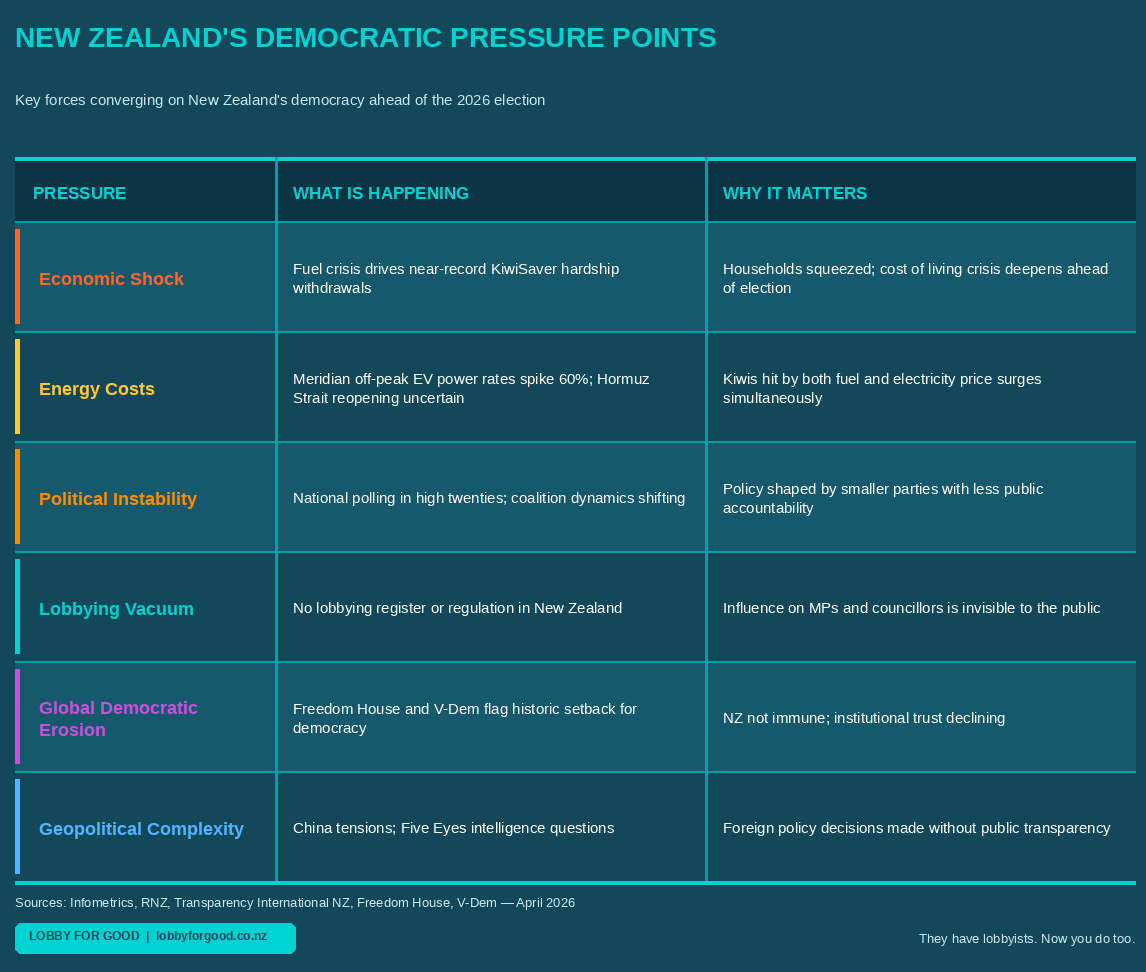
New data released this week shows KiwiSaver hardship withdrawals spiked to a near-record high last month. Over 5,600 New Zealanders raided their retirement savings just to keep their heads above water amid surging fuel prices and cost-of-living pressures .
For those trying to escape the fuel crisis by switching to electric vehicles, the alternatives are suddenly looking bleak. Meridian Energy customers woke up this week to find their off-peak EV charging rates had been hiked by a staggering 60 percent . If you cannot afford fuel, and you cannot afford power, what are your options?
There was a brief glimmer of hope today when Iran announced the Strait of Hormuz was “completely open” to commercial shipping following a ceasefire in Lebanon . But within hours, the United States confirmed its blockade on Iranian ships and ports would remain in full force until a broader deal is reached . The uncertainty remains, and New Zealand households are the ones paying the price at the pump.
But the economic tremors are only half the story. The other half is political - and it is playing out both globally and right here at home.

A Global Pattern Worth Paying Attention To
Around the world, a concerning pattern has been building for years. In established democracies, the concentration of executive power, the weakening of institutional checks and balances, and the influence of unregulated lobbying have been steadily eroding public trust. The Varieties of Democracy project and Freedom House both flagged in their March 2026 reports that global democracy is experiencing a historic setback - one in which elections alone no longer guarantee democratic systems .
The recent defeat of Viktor Orbán in Hungary offered a rare and important signal. After 16 years of what many described as a systematic dismantling of democratic institutions - captured courts, a controlled media landscape, and patronage networks designed to reward loyalty - Hungarian voters turned out in record numbers and delivered a decisive verdict . Orbán’s model had been celebrated by populist movements globally. His defeat was not just a Hungarian story. It was a reminder that democratic resurgence is as possible as democratic backsliding - but only when citizens are informed, engaged, and organised.
The lesson for New Zealand is clear - the health of our democracy is not guaranteed. It requires active participation, not passive observation.
What Is Happening Here at Home
Closer to home, the political temperature is rising - and the signals are worth reading carefully.
The current coalition government is under significant internal pressure. National’s polling has slipped to the high twenties, and questions about the Prime Minister’s leadership have dominated the week’s political coverage, with senior ministers publicly urging caucus colleagues to “hold their nerve” . Meanwhile, New Zealand First has surged to 15 percent in recent polling, meaning that the influence of smaller coalition partners over policy is becoming disproportionately large - and the negotiations that shape those policies happen largely out of public view .
For everyday New Zealanders, this matters. When power concentrates in smaller, less visible spaces, the decisions that affect your community - on infrastructure, on social services, on local government funding - can be locked in before the details are even public.
And the transparency problem runs deeper than any single party or leader.
Transparency International New Zealand’s 2026 Corruption Scan, released this week, found that while New Zealand’s public sector remains largely free from systemic corruption, public concern is growing around perceived influence - particularly related to political donations, lobbying, and government decision-making processes . The report notes that calls for greater transparency, lobbying regulation, and tighter controls on political financing continue to gain traction.
Here is the uncomfortable truth we’ve been speaking about and why we exist: New Zealand has no regulations on lobbying. None. Anyone can walk into Parliament or a council meeting and influence decision-makers - if they can afford to pay someone to do it.
Yes, everyday New Zealanders have the ability to go and talk to their MPs or councillors. But let’s be realistic. Do you have the ability to read every 500-page agenda? Do you know how to spot what is buried in the fine print? Do you know what decisions are coming down the pipeline before they hit the news, or how to decipher the bureaucratic language they are written in?
Professional lobbyists do. Big businesses and industry groups spend tens of thousands of dollars a month on them to shape policy before you even know it is happening. And this is not just a problem with the political right — it happens on the left, too.
When the previous Labour government was designing the Emissions Trading Scheme rules, a former Labour chief-of-staff turned lobbyist was texting Cabinet ministers directly to ensure his forestry client’s interests were protected. Under the current National-led government, we have seen the supermarket duopoly successfully lobby to water down the Commerce Commission’s recommendations to break them up, and the alcohol industry working closely with Ministry of Health officials on plans that are supposed to address alcohol harm.
Whether it is unions or property developers, big tobacco or big tech, the playbook is the same: use money and access to shape the rules while everyday New Zealanders find out about decisions that affect them after they have already been made.
That is not democracy. That is a two-tier system dressed up as one.
Where New Zealand Fits in the World Right Now
We are also navigating a more complex geopolitical environment than at any point in recent memory. China has lodged a formal protest over the activities of a New Zealand Air Force aircraft, and questions are being asked about the future of our intelligence relationships as the global order shifts. New Zealand’s intelligence agencies are reportedly weighing how much to share with the United States under the current administration - a sign that even our most foundational alliances are being stress-tested.
New Zealand has always prided itself on an independent foreign policy. But independence requires clarity of purpose, and clarity of purpose requires an informed public. When decisions about our strategic relationships are made in classified briefings and diplomatic back-channels, with no public accountability, that independence becomes something only our leaders get to define.
What to Watch For Between Now and November
The months ahead will be noisy. Promises will be made, rhetoric will escalate, and the spin machine will work overtime. Here is what we think you should be watching - and what we will be tracking on your behalf.
Watch whether any party commits to a lobbying register before the election.
Watch how the coalition manages the economic pressure of rising fuel costs and whether the response prioritises households or industry.
Watch how our foreign policy is communicated — not just what our leaders say in press conferences, but what they are actually doing in the rooms we cannot see.
And watch the polls not as a horse race, but as a measure of public trust - because when nearly half the country believes we are heading on the wrong track, that is a signal about the quality of our democracy, not just the popularity of individual leaders.
Most importantly, watch what your own MP and councillors are doing. Not what they say. What they do.
Something Is Coming. And We Want You In First.
At Lobby for Good, we have spent four years building the tools to help everyday New Zealanders do exactly that.
On 14 May 2026, we are launching New Zealand’s first Civic Intelligence Platform. It is built independently, will be funded by members, and designed to give you the same intelligence that councils and government agencies pay consultants tens of thousands of dollars for.
Inside the portal, as we grow our membership you’ll will find:
• MP and Councillor Voting Records - tracking every parliamentary vote and council decision, and know exactly where your representatives stand before it affects you.
• Policy Promise Tracker - what was promised before the election, and what has actually happened since. Every promise tracked and verified.
• AI Civic Advisor - ask plain-language questions about New Zealand government, council processes, and your rights, and get clear, sourced answers instantly.
• Community Lobbies - when enough members care about the same issue, we aggregate your concerns into a formal submission to Parliament or your local council.
We keep you informed - so together, we can be your lobbyist, for good.
New members who join before the portal opens to the public will receive exclusive early access to test drive every feature, and direct input into what we build next. Founding member spots are limited.
From $10 a month. Less than 2 coffees per week. Cancel any time.
They have lobbyists. Now you do too.
Join the movement and secure your founding member spot at www.lobbyforgood.co.nz
References
[7] Swiss Info. (2026, April 16 ). When is a democracy no longer a democracy?
[11] Transparency International New Zealand. (2026, April 16 ). TINZ Corruption Scan March 2026.
Lobby for Good is New Zealand’s first independent civic intelligence platform. We are not affiliated with any political party. Our mission is to keep you informed - so together, we can lobby for a better New Zealand. Join us at www.lobbyforgood.co.nz.

I would argue that if any minor Party rises in the polls, then one would expect it to have a greater voice in any coalition - I don't think you can say that it means :
"the influence of smaller coalition partners over policy is becoming disproportionately large - and the negotiations that shape those policies happen largely out of public view".
I do think you were right in your first analogy - of ourselves in the public being like passengers on a ship steered by unseen hands - but I would assume that every political Party negotiates and forms its policies " largely out of public view".