


New Zealand is making decisions about cloud procurement, land, electricity, water, and public money through separate processes. The public still has no clear account of the combined cost, benefit, and risk.
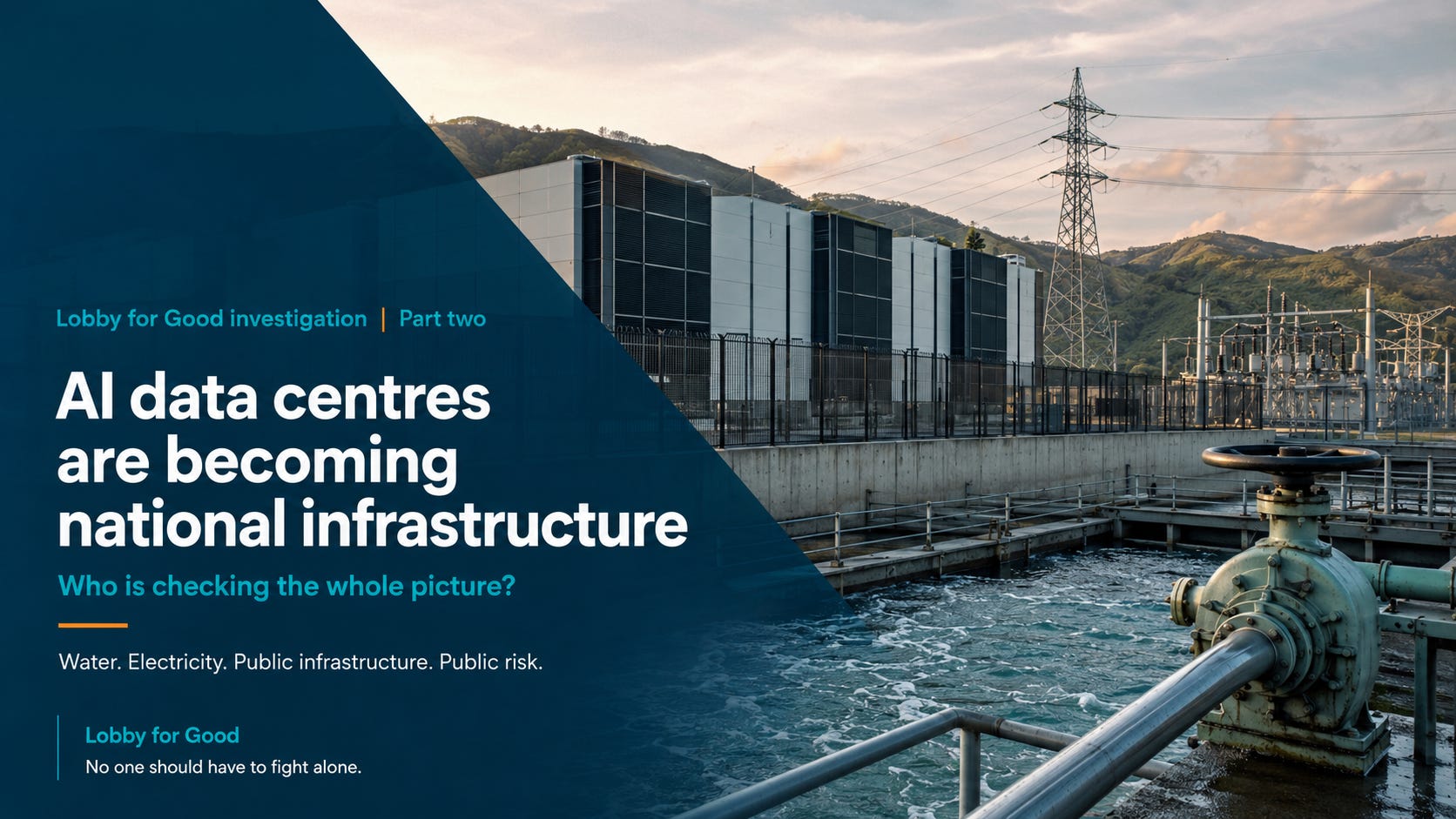
To understand the problem, it helps to look at how one data centre proposal may move through the system.
A government agency may see a cloud contract. A council may see a planning application. A regional council may see a water consent. An electricity company may see a large new connection. Transpower may see another source of future demand. The Overseas Investment Office may see an application involving overseas investment, sensitive land, or significant business assets.
Each organisation may assess the part it is responsible for.
Each may be doing its job properly.
The gap is that no organisation appears to be responsible for presenting the public with the combined effect.
Everyday New Zealanders do not experience these decisions separately. We live with the total demand on water, electricity, land, public infrastructure, and government systems.
New Zealand is being encouraged to see artificial intelligence as an economic opportunity. International technology companies are investing in local infrastructure. Government agencies can purchase cloud services through established agreements. Data centres are appearing in electricity forecasts, planning processes, and economic development discussions.
Taken separately, these may look like procurement, planning, investment, or energy decisions.
Taken together, they begin to shape a national infrastructure direction.
Who is responsible for assessing the combined impact?
Who is adding up the demand for water and electricity?
Who is tracking the roads, substations, grid connections, fibre, and council infrastructure these developments may require?
Who is measuring the permanent jobs, tax revenue, and other public benefits?
Who is checking whether the risks sit with the developer or are being shifted onto ratepayers, electricity consumers, and communities?
In the public material reviewed for this article, we did not find one document that brings these questions together - which is important because separate decisions can create a national infrastructure direction, even when nobody formally calls it a strategy.
The public deserves one clear account of what is being built, what it will require, who will benefit, and who will carry the risk.
From water use to the wider system
Those questions remain important however, water is only one part of the system.
A major data centre may also affect electricity demand, grid investment, council infrastructure, land use, overseas ownership, public procurement, government information, and New Zealand’s reliance on a small number of international cloud providers.
Those decisions are often made by different organisations through separate processes. That makes it difficult for the public to see what New Zealand is building, what it will require, and who will carry the cost.
Cloud services are becoming easier for agencies to purchase
New Zealand already has government-wide or cross-government arrangements covering several major cloud providers.
The Google Cloud Framework Agreement allows eligible agencies to purchase Google public cloud and professional services under standardised terms.
The Amazon Web Services Cloud Services Agreement provides a common contractual arrangement for eligible agencies purchasing Amazon cloud services.
The Microsoft Cloud, Software and Services Agreement covers Microsoft software, cloud services, and related licensing.
These agreements can reduce the time and cost involved in procurement. They may also give agencies access to terms negotiated across government rather than one organisation at a time.
They are purchasing arrangements.
They do not, by themselves, require data centres to be built in New Zealand. They also do not prove that every eligible agency uses each provider.
They do, however, reduce some of the barriers involved in purchasing those services.
At the same time, the Government’s cloud policy encourages agencies to consider public cloud services. It requires an exception process for new investment in on-site information technology infrastructure.
Current policy also says agencies should, over time, store restricted information in a New Zealand data centre where a suitable onshore service exists.
That may support security, resilience, and local data storage. Yet, it may also increase the public sector’s reliance on the companies providing those services which makes the terms of that reliance important.
How many agencies use each provider?
What is the total public spending?
How difficult would it be to change provider?
Can information and essential services be transferred without unreasonable cost or disruption?
What happens if prices, ownership, products, or contractual terms change?
The existence of a purchasing agreement does not answer those questions.
Local cloud infrastructure is already developing
Microsoft opened its New Zealand North cloud region in December 2024. The company describes it as New Zealand’s first hyperscale cloud region.
Google has announced plans for its first New Zealand cloud region in Auckland. The official announcements reviewed for this article describe the planned region and its intended benefits, but do not provide a confirmed opening date.
Other data centre projects and expansions have also been proposed or discussed in different parts of New Zealand.
For what it’s worth, large data centres do not operate in isolation. They depend on land, reliable electricity, grid or network connections, fibre, and local infrastructure. Depending on the development, they may also require water, wastewater capacity, road upgrades, and other public services.
They may become increasingly important to government agencies that move information and essential operations into the cloud. Transpower has already identified data centres as one of the sources that could contribute to future electricity-demand growth.
Its October 2024 monitoring report referred to emerging data centre demand and listed it among the additional drivers of underlying electricity use.
That does not mean every proposed development will proceed. It does mean data centres are no longer only a technology-sector issue. They are becoming part of New Zealand’s infrastructure planning.
A national direction without a public strategy
There may be no single Cabinet paper titled “New Zealand’s national data centre strategy”.
But the decisions described above are moving in the same direction.
When you look at this together, it begins to shape:
Where New Zealand’s information is held
How essential public services operate
What electricity, water, and local infrastructure must be built
What the public may be asked to fund
Which international providers public services may become difficult or expensive to leave
That is a national infrastructure direction, even if nobody formally calls it a strategy. The public should be able to see it.
What New Zealand may gain
Local cloud infrastructure and data centres may bring real benefits.
They may provide faster access to cloud services, increase local computing capacity, support research and digital services, and make it easier to store some information in New Zealand.
They may also create construction work and ongoing specialist jobs and these are reasonable arguments.
However, a company announcement only tells us what a development is expected to achieve. It does not tell us what it eventually delivers.
For every major proposal, the public should be able to see:
The construction and permanent jobs expected
The kinds of jobs and likely pay levels
The tax expected to be paid in New Zealand
Whether local businesses will supply or use the facility
Whether it will mainly serve New Zealand or overseas markets
The public infrastructure it requires
Any public funding or commercial support it receives
How the promised benefits will be checked after approval
Investment tells us that money is being spent, but it does not tell us who benefits or who carries the risk.
Who pays for what must be built?
A large data centre likely requires new electricity generation, transmission capacity, substations, local lines, roads, fibre, water systems, or wastewater infrastructure. Maybe, the developer will pay some of those costs directly. Other costs may be recovered through commercial connection charges.
Some may ultimately affect electricity prices, network charges, council borrowing, rates, or government spending.
The arrangement will differ between developments, which is why the full account should be published.
The public should not have to piece together the financial arrangement from council reports, technical appendices, company announcements, and regulatory decisions.
The benefits and costs may not fall in the same place. A developer may receive the commercial return while councils, electricity networks, consumers, and communities carry parts of the infrastructure cost or shortage risk. Government agencies may also become reliant on providers that are difficult or expensive to leave.
Even the jobs promised may be concentrated during construction, with far fewer permanent roles once a facility begins operating.
None of those outcomes is inevitable.
That is why the arrangements should be visible before public money, infrastructure, or resources are committed.
The public infrastructure account
Lobby for Good believes every major data centre proposal should include one clear public infrastructure account.
It should show:
Expected electricity and water demand
The proposed cooling system
The grid, roads, fibre, water, and council infrastructure required
Who will build, fund, own, and maintain each part
Who carries the risk of delays or cost overruns
How households and other electricity or water consumers may be affected
Any public funding, tax treatment, concession, or commercial support
The construction and permanent jobs promised
The wider public benefits claimed
How those benefits will be independently measured
What happens if the project is delayed, reduced in scale, or does not proceed
What happens if the promised benefits are not delivered
This would allow councils and communities to compare developments using the same basic standard.
At present, the information available may depend on where a project is proposed, which approval process applies, and what the developer chooses to disclose.
That is not a clear national system.
A public infrastructure account would make the costs, benefits, and risks easier for everyone to understand. Before the haters come in, this is not anti-business. Good businesses should be able to explain what they need, what they will contribute, and what New Zealand will receive in return.
Five questions every political party should answer
New Zealand needs more than broad promises about artificial intelligence, investment, or economic growth.
Before the election, every political party should answer five practical questions.
1. What resources should data centres be allowed to use?
Should companies disclose expected water use before approval?
Should drinking water be used for industrial cooling?
Should recycled or non-potable water be required where practical?
Who receives priority during drought restrictions?
2. Who should pay for the electricity infrastructure?
Should large developments fund the new generation, grid capacity, substations, and local connections associated with their demand?
Should that expected demand be made public before major connection agreements are completed?
How will the effect on other electricity consumers be assessed?
3. What public assistance should be available?
Should developers receive subsidies, tax concessions, council infrastructure support, or favourable commercial terms?
If assistance is provided, should it all be published in one place?
What should New Zealand receive in return?
4. What should companies have to report?
Should major data centres publish their annual electricity use, water consumption, emissions, permanent employment, and public assistance received?
Should they report whether the benefits promised during approval were delivered?
Should that information be (truly) independently verified?
5. How dependent should public services become?
How much public information should be held by overseas cloud providers?
What exit and continuity plans should agencies maintain?
Can an essential public service move its information and operations without unreasonable cost or disruption?
What happens if a provider changes its prices, ownership, services, or operating model?
These are the questions any serious infrastructure policy should answer.
What we are investigating
Lobby for Good is building the public record behind these decisions.
We are seeking information from ministers, political parties, councils, government agencies, electricity organisations, and proposed developers.
We want to know:
What electricity and water forecasts are being used
What infrastructure developers expect the public sector to provide
What assistance has been requested, discussed, or offered
Which companies have met with ministers, officials, councils, and electricity organisations
What environmental and financial risks have been identified
What advice and alternatives were given to elected representatives
What protections exist if public agencies need to change cloud providers
What decisions or commitments were made before public consultation
What you can ask locally
Most people will not first hear about a data centre through a national infrastructure strategy.
You may see a short item in council papers, a planning application, a water consent, a proposed substation, or a road upgrade By then, important assumptions may already have shaped the proposal.
You do not need to be an engineer, lawyer, or electricity expert to ask sensible questions.
What infrastructure will this require?
Ask about electricity, water, wastewater, roads, fibre, and emergency services.
Who will pay for it?
Ask who will build, own, maintain, and eventually replace each part.
What are the expected water and electricity demands?
Ask for the assumptions behind the totals and any expected future expansion.
What information came from the developer?
Ask what was independently checked, who checked it, and what alternatives were considered.
What happened before public consultation?
Ask for meeting records, correspondence, presentations, financial models, and any early commitments.
What happens if the development changes or fails?
Ask about shortages, delays, cost overruns, reduced demand, closure, and failure to deliver the promised benefits.
Ask for the reports, the assumptions, the records behind the decision. Keep the responses together and build a paper trail.
The records may help answer your local questions, however they may also reveal whether the same pattern is appearing elsewhere.
Help us build the public record
Is a data centre or another large industrial development being proposed near you? Have you seen a council report, consent notice, infrastructure agreement, meeting record, or public presentation?
Add it to the record through the Lobby for Good Portal
Tell us:
Where the development is proposed
Which council or agency is involved
What stage the proposal has reached
Which public documents are available
What water or electricity information has been disclosed
What questions remain unanswered
One report may describe one local proposal.
Reports from several regions can reveal whether the same assumptions, funding arrangements, or information gaps are appearing across the country.
That is how civic intelligence is built.
This conversation should belong to everyone
Artificial intelligence may bring real benefits to New Zealand. It may also place new pressure on electricity, water, public infrastructure, and government systems that are already expensive and difficult for the public to understand.
We should not reject infrastructure simply because it is new, but we should not just approve it simply because it is described as progress.
The public standard should be clear:
Show us the evidence.
Show us the resources required.
Show us what the public is being asked to fund.
Show us what New Zealand receives.
Show us who carries the risk.
Then give the people affected a meaningful chance to participate before the important decisions have already been made.
Large technology companies have advisers, lawyers, consultants, and direct access to decision-makers.
Everyday New Zealanders should not have to reconstruct the other side of the story from dozens of separate reports. That is why Lobby for Good is following these decisions.
This investigation requires source checks, information requests, analysis, and ongoing scrutiny. Membership helps fund that work and keeps public-interest information accessible.
Join Lobby for Good and help build the people’s lobby.
No one should have to fight alone.
References
New Zealand Digital Government: Cloud adoption policy and strategy
New Zealand Digital Government: Cloud First policy requirements
New Zealand Digital Government: Google Cloud Framework Agreement
New Zealand Digital Government: Amazon Web Services Cloud Services Agreement
New Zealand Government Procurement: Microsoft Cloud, Software and Services Agreement
New Zealand Government Procurement: Guidance for sourcing cloud services
Microsoft: New Zealand’s first hyperscale cloud region opens
Google Cloud: New cloud regions announced for New Zealand and Asia-Pacific
Google Cloud: Auckland selected for New Zealand cloud region
Transpower: Whakamana i Te Mauri Hiko monitoring report, October 2024
Toitū Te Whenua Land Information New Zealand: Overseas investment regulation
Toitū Te Whenua Land Information New Zealand: Overseas investment guidance
Read Part one:
Water Reform Settled Who Manages the System. It Did Not Ask Who the System Must Serve.
·
Three Waters and Local Water Done Well were fiercely debated. The future water demands of data centres and other large industrial developments received far less public attention.

https://claimanalysis.substack.com/p/the-compliance-framework-as-scenery I eventually get to data centres in this article, but the lead in is important. It may fill in some gaps for you.
OMG - you have certainly gone into the depths of what is supposed to be marvellous for NZ. However, I wonder if it really is. Why in NZ - plenty of other countries around the world.